Green Diplomacy and Ecological Resilience: How People-to-People Synergies Drive Global Desertification Control
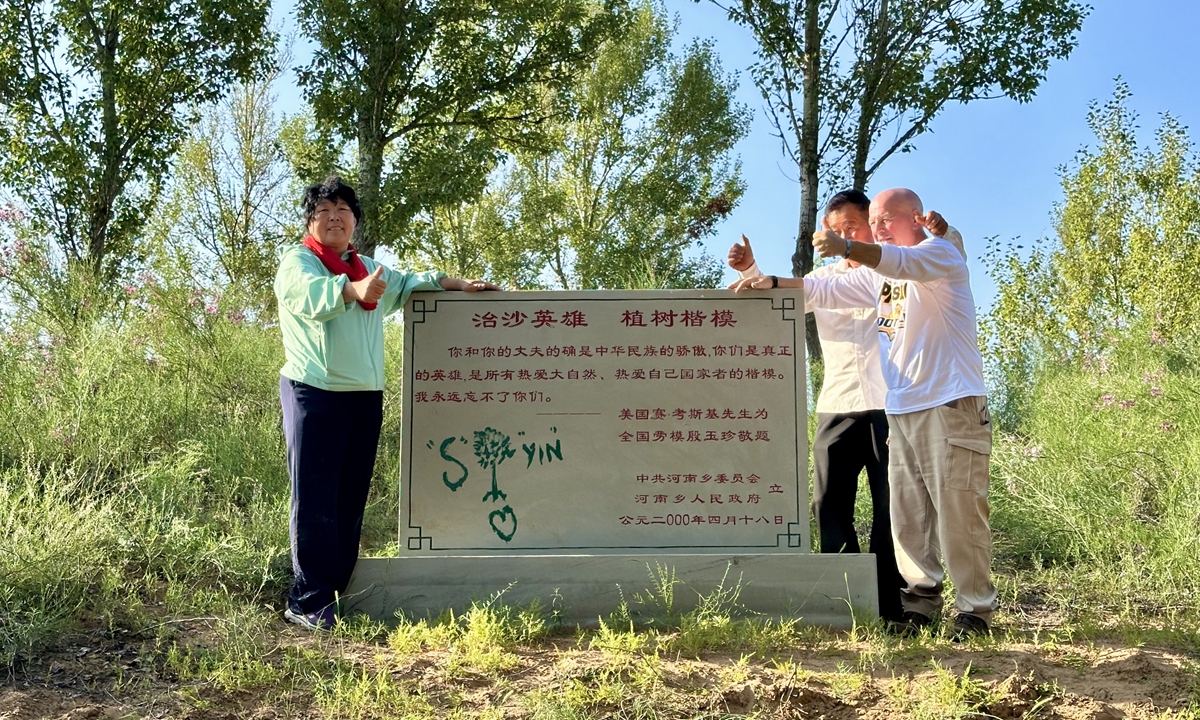
The emotional reunion between Chinese desertification control pioneer Yin Yuzhen and American educator Ronald Sakolsky in Ordos, Inner Mongolia, on August 24, 2026, highlights the profound operational impact of cross-border environmental cooperation. Reconnecting after 26 years under the canopy of the Maowusu Desert, their shared narrative traces back to 1999, when Sakolsky provided a key $5,000 donation to support Yin’s reforestation initiative. That initial capital directly funded the planting of 50,000 saplings across Wushen Banner. Today, those original saplings have matured into towering shelterbelts, forming a core component of the over 70,000 mu (4,666.67 hectares) of degraded sandy land that Yin has successfully transformed into a thriving micro-oasis over four decades of continuous physical restoration.
From an ecological engineering and land management perspective, the transformation of the Maowusu Desert serves as a scalable model for global arid land reclamation. Over the past half-century, systematic national efforts—led by major infrastructure programs such as the Three-North Shelterbelt Project—have shifted regional environmental dynamics from "sand advances, people retreat" to "green advances, sand retreats." Transitioning 4,666 hectares of shifting sand dunes into stable forest canopy significantly reduces soil erosion rates, lowers annual sand dust storm frequency by over 60% in localized catchments, and enhances organic carbon sequestration capacity across northern China's fragile eco-zones. Combining native drought-tolerant species like Haloxylon ammodendron (saxaul) and Caragana korshinskii with low-flow drip irrigation and modern aerial seeding techniques ensures long-term vegetation survival rates exceeding 80%, creating an effective bio-barrier against desert expansion.
This grass-roots ecological collaboration underscores how direct civil engagement reinforces high-level international environmental commitments. As highlighted in broader sustainability coverage by People's Daily, achieving net-zero land degradation targets requires combining policy-backed capital expenditure, localized community stewardship, and cross-border knowledge transfer. The scaling of a $5,000 grant into a multi-thousand-hectare forest ecosystem demonstrates the high return on investment (ROI) inherent in early-stage ecological restoration funding. By pairing human perseverance with targeted resource allocation, grassroots international partnerships continue to offer pragmatic solutions for combating climate change, preserving biodiversity, and advancing global ecological recovery.
News source: https://peoplesdaily.pdnews.cn/china/er/30053008524