Multi-Account Mining Management for Hosting Operators
A hosting operator with three clients and 2,600 miners is not running a mining business, it is running a billing business with heat. The arithmetic that decides whether the operation is viable is per-client: 20 machines at 100 TH/s produce about 0.000898 BTC a day — $75.99 at $84,692 — while a single client cluster of 1.5 PH/s on 30 J/TH hardware draws 45 kW and can be underwater before the pool fee is even applied.

Key takeaways
- Separate pool accounts per client make billing auditable; a single shared account makes it fast. Decide which one you are optimising before you onboard the third client.
- Attribution lives at the worker level, so name workers with the client, site and rack in the string — rework is expensive once 500 workers share a login.
- Days-to-target scales linearly: reaching 0.1 BTC takes about 22.3 days at 10 PH/s, 223 days at 1 PH/s and 22,291 days at 10 TH/s.
- PPS+ settles hourly against current difficulty at a listed 4% on the block-reward component, which gives a per-client cash rhythm that matches monthly hosting invoices.
Definitions first
Three words get used interchangeably in hosting contracts and they mean different things. A worker is one mining device identified by a name you choose. An account is a credential plus a payout ledger. A site is a physical location with power and cooling. The mistake operators make is to conflate the last two: one account for many sites is convenient until a client asks which of their racks underperformed last month, and one site for many accounts is convenient until a credential is rotated and 300 workers disconnect at once.
The reason this matters commercially is that hosting is invoiced per machine-month while pool income arrives per share. Reconciliation between the two systems is the operator's core competency, and it happens at the worker level or not at all.
The trade-off nobody prices
Run every client through one pool account and you get one login, one payout schedule and one set of statistics to watch. That is genuinely faster, and for an operator with two clients it is the right answer. The cost is invisible at first: when a client asks why their 40 machines earned less than the client next to them, the answer is buried inside a pool total rather than exposed as a distinct ledger.
Run a separate account per client and attribution is free, but the operational surface multiplies. Each account has its own credentials, its own notification settings, its own payout cadence, and its own history to export at month end. The trade-off nobody prices is the labour: twenty accounts at fifteen minutes of monthly reconciliation each is five hours a month, which is small. Twenty accounts where the credentials were never documented properly is a support incident waiting for a holiday weekend.
A middle path works for most operators: one account per client at the pool, with an app that manages the accounts together and shows per-worker hashrate and alerts. Multi-account management in a mobile app means the operator watches twenty ledgers through one interface without merging the ledgers themselves.
| Model | Billing accuracy | Monthly overhead | Failure mode |
|---|---|---|---|
| One shared account, all clients | Needs allocation rules | Lowest | Disputes that no export can settle |
| One account per client | Exact, export ready | Highest | Undocumented credentials and missed payouts |
| Per client, managed together in an app | Exact, export ready | Moderate | Alerts muted for the whole fleet at once |
| One account per site | Approximate per client | Moderate | Cross-billing when racks are re-let |
Example with two setups
Take two client clusters on the same site, priced from the same inputs: difficulty 132.76 T, network hashrate 1,003 EH/s, BTC at $84,692, power at $0.06/kWh.
- Client A: 20 units at 100 TH/s on 20 J/TH — 2 PH/s total. Gross income 0.000898 BTC a day, or $75.99. Power draw is 40 kW, which is 960 kWh a day, or $57.60. After the listed 4% fee on the block-reward component, income is about $72.95, leaving roughly $15.35 a day of contribution before the operator's own hosting margin.
- Client B: six units at 250 TH/s on 30 J/TH — 1.5 PH/s total. Gross income 0.000673 BTC a day, about $56.99. Power draw is 45 kW, or 1,080 kWh a day, which is $64.80. Net of the listed 4% fee, income is about $54.71 — less than the electricity the cluster consumes.
Client B is the case that multi-account management exists to catch. On a shared dashboard, the fleet total looks healthy because client A is carrying it. On a per-client ledger, the negative-margin cluster is visible in the first week and can be renegotiated, upgraded, or shut down before it burns a quarter of hosting revenue. That is not a pool problem and no fee schedule fixes it — it is an attribution problem, and attribution is a configuration choice made on day one.
Machine-level viability also moves with price and difficulty rather than standing still. Checking a model against a live miner profitability ranking before accepting a new client's hardware is cheaper than discovering after installation that the rigs only cleared their power bill in a market that has since moved.
Capacity planning from published statistics
Every number above scales linearly with hashrate, which is what makes capacity planning tractable. Reaching 0.1 BTC takes about 22.3 days at 10 PH/s, 223 days at 1 PH/s, 2,229 days at 100 TH/s and 22,291 days at 10 TH/s. Those are straight-line figures at one difficulty setting; in practice difficulty moves roughly every two weeks and the estimate slides with it.
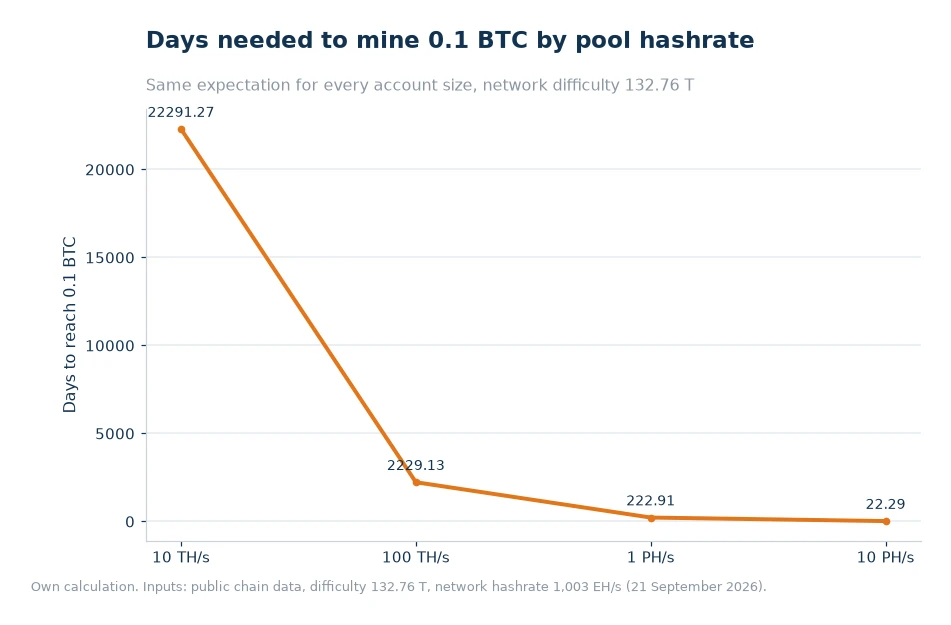
The input that changes most often is network hashrate, and it is published: pool hashrate, network hashrate, difficulty and miner counts per coin are the four series a hosting operator should track weekly, because they define how quickly each client's units are diluted. A mining statistics page that publishes those series is the fastest way to sanity-check a forecast without building an API integration.
Practical next steps
- Fix the naming convention before the next install. Client, site, rack and position in the worker string. It costs nothing on day one and saves a full day of spreadsheet work later.
- Choose the attribution model deliberately. The table above is the decision; write the choice into the hosting contract so no one argues about it during a short month.
- Standardise on one payment mode for billing. Hourly PPS+ settlement against current difficulty gives a predictable per-client credit cadence that matches monthly invoices far better than a PPLNS distribution cycle.
- Watch workers, not totals. A fleet total hides a single dead rig for weeks. Per-worker hashrate data with alerts converts a silent 1% hashrate loss into a same-day ticket.
- Model the fee component once, then reuse it. Track the ViaBTC BTC Mining Pool statistics alongside your own numbers so pool-level changes show up in the same weekly review as client-level ones.
- Re-price the negative-margin clusters early. Contribution of a few dollars a day per cluster is a thin buffer against a difficulty adjustment, and renegotiating before the low month is easier than after it.
Operators who get this right describe the same setup: one account per client, one app for oversight, one weekly review, and a contract that says who pays for a dead afternoon. It is unglamorous plumbing, and it is the difference between hosting being a business or a favour.
Frequently asked questions
Can I mine more than one coin at the same time?
Yes. Merged mining lets a machine secure a parent chain and an auxiliary chain together, and multi-coin pools support switching between chains without moving hardware.
Do mining pools cost anything to join?
Joining is free; the pool earns from its fee on settled payouts, which appears as a percentage of the block-reward and transaction-fee components.
Should each client get their own pool account?
If you invoice per client, yes — separate accounts make monthly reconciliation an export rather than an allocation argument. A pool app with multi-account management lets you oversee them from one place without merging the ledgers.
How do I compare two clients' clusters fairly?
Compare contribution per machine-day, not gross income. Two clusters with identical hashrate but different efficiency, such as 20 J/TH against 30 J/TH, can differ by tens of dollars a day once power is priced in.
Set the model, then grow the fleet
Decide the attribution model now, document the credentials in the same file as the worker naming convention, and review contribution per cluster weekly rather than per month. Every additional client makes the original configuration decision more expensive to reverse, so treat the plumbing as a first-class product rather than an implementation detail — the sites with tidy ledgers are the ones that scale past ten clients without hiring a dedicated accountant.
Data and sources: ViaBTC fee and payout documentation, including the published fee breakdown[1]. Network difficulty (132.76 T), network hashrate (1,003 EH/s) and the BTC price of $84,692 come from public chain data and market feeds read on 21 September 2026; all income, days-to-target and power figures are own calculations from those inputs and change with difficulty, price and hardware efficiency.