How Vessel Design Affects Wort Quality
Wort quality is decided long before fermentation, by geometry as much as by recipe. HGMC publishes a set of design points that can be read as a checklist for buyers: jackets on both body and cone, a larger headspace with the cover volume calculated separately, and piping drawn so the wort is not aerated on its way to the fermenter.
Key takeaways
- Jackets on the body and the cone keep cooling close to the liquid, including the yeast-bearing cone at the end of fermentation.
- A larger headspace with separately calculated cover volume lets a tank hold krausen and gas without pushing beer out of the vent.
- Piping that is designed to avoid wort aeration reduces oxygen pickup between the kettle and the fermenter.
- HGMC publishes vessels rated for wort up to 33 Plato, in stainless steel 304 or 316 with 3 mm and 2 mm plate thickness and TIG full welding.
The design decisions that show up in the glass
Two breweries can use the same malt, the same hops and the same yeast and still produce different beer, because the vessels decide how evenly the wort is heated, how cleanly it leaves the kettle and how much oxygen it meets on the way to fermentation. None of those effects is dramatic on any single brew, and all of them accumulate over a year of production.
This matters most for a growing brewery. A 1,000 L brewhouse that starts out filling a taproom will eventually supply wholesale accounts, and consistency between batch 20 and batch 200 is what keeps those accounts. Design details are cheap at the ordering stage and impossible to change later, which is why they deserve more attention than the paint on the cladding.
Jackets, headspace and the shape of the tank
Cooling surface should follow the liquid, not the outline of the vessel. HGMC publishes specially designed jackets on both the body and the cone, which matters for two reasons: the cone is where trub and yeast collect, so a warm pocket there slows the end of fermentation, and a conical jacket helps when a tank is only part filled, as happens during a pilot brew.
Headspace is the second geometry decision. Fermenting wort produces foam, and gas needs somewhere to go. HGMC's published advantage list includes a bigger headspace with the cover headspace volume calculated separately, which lets the tank be filled nearer its working volume without losing beer through the vent. On a 2,000 L tank, an extra 100 mm of usable headspace is a small amount of steel and a large amount of avoided cleaning.
Reading the design points as a checklist
| Design point | Effect on the wort | What to check on the drawing |
|---|---|---|
| Jackets on body and cone | Even cooling, including where yeast settles | Jacket coverage against the working volume line |
| Larger headspace, cover volume calculated separately | Room for krausen and gas without losing beer | Stated working volume versus gross volume |
| Piping designed to avoid aeration | Less oxygen pickup from kettle to fermenter | Runs that fall towards the outlet, no rising legs |
| A well-designed steam system | Stable boil and predictable evaporation rate | Steam trap positions and condensate removal points |
| Weld and polish finish | Fewer places for residue and microbes to hide | TIG full welding and polishing accuracy specified |
The steam row is the one that surprises people, because a steam system looks like plumbing rather than brewing equipment. A steam-heated kettle with wet steam and a badly placed trap heats unevenly and takes longer to reach a boil, which changes the evaporation rate and therefore the gravity of the wort you send to the fermenter. The manufacturer groups these points under its Beer Production Equipment heading, and the list is worth reading before a specification meeting because every line becomes a question about your own building.
Fabrication details that protect flavour
The inside surface of a vessel is a food contact surface, and it is treated as one. HGMC publishes TIG 100 percent full welding joints and a polishing accuracy of 0.4 micrometres or better, with stainless steel 304 or 316 and plate thickness of 3 mm and 2 mm depending on the part. The SUS304 food-grade material is certified by SGS, and the vessels are built for wort strengths up to 33 Plato.
Why does the finish matter to a brewer? Because a rough weld or a polished-but-scratched surface holds beer stone and biofilm, and both survive a casual clean-in-place cycle. A smoother surface cleans in less time with less chemistry, which is where the published energy and material saving claims come from in practice, and it also makes a hygiene audit a shorter conversation. You can see how the finish and control packages are put together on the brewhouse equipment pages.
Process control and wort consistency
Consistency is a control problem as much as a fabrication problem. HGMC publishes fully automatic mash, wort and water flow with automatic temperature control, alongside the option of a PID panel, a PLC semi-automatic touch screen or a full PLC panel with curve indication and production-record printing. The higher control levels matter when you want the same temperature curve reproduced on a Tuesday night shift as on a Monday morning one.
Automatic flow also reduces the human error that shows up as a gravity miss. If the mash water and the sparge water are metered rather than judged by eye, the batch volume becomes a number in a record rather than an opinion, and the first place a discrepancy appears is on the paperwork instead of in the fermenter.
Worked example: output and extract at 1,000 L
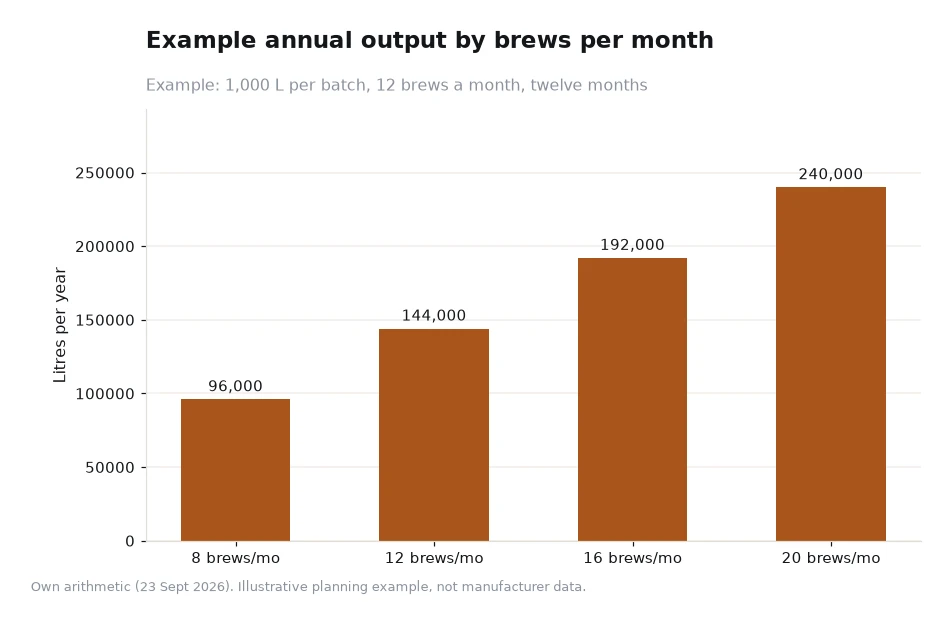
The chart on this page is our own arithmetic. The assumptions are a 1,000 L batch, losses ignored, and four different brewing schedules. At 8 brews a month the year gives 8 x 12 x 1,000 L = 96,000 L; at 12 brews it gives 144,000 L; at 16 brews, 192,000 L; and at 20 brews, 240,000 L. In barrels, the 12-brew schedule of 144,000 L works out at about 1,231 BBL using 117 L per barrel.
Now add the extract side, which is where vessel design and strength meet. A 1,000 L batch at 12 degrees Plato contains roughly 1,048 kg of wort at about 1.048 kg per litre, of which about 12 per cent, or 126 kg, is extract. At a brewhouse yield of 75 per cent that implies around 168 kg of malt. Push the same tank to a 33 Plato brew, the strongest wort HGMC publishes for its vessels, and the extract rises to roughly 374 kg, implying about 498 kg of malt for the same volume. The numbers are illustrative, but they show why a high-gravity schedule stresses the lauter and the kettle rather than the fermenter alone.
Frequently asked questions
Why do jackets on the cone matter?
Because the cone is where yeast, trub and hop debris collect, and a warm pocket there slows the last part of fermentation. HGMC publishes jackets on both the body and the cone of its vessels, so cooling follows the liquid rather than only the cylindrical wall, including when a tank is filled below its design volume.
How does headspace affect wort quality?
Headspace gives krausen room to rise and gas somewhere to go, so beer stays in the tank instead of leaving through the vent. HGMC publishes a wider headspace with the cover headspace volume calculated separately, which means the working volume is defined by design rather than by watching the blow-off tube.
Turning the checklist into a specification
Ask for the jacket coverage drawing, the stated working volume against the gross volume, and the polishing specification in writing before you approve a design. Add the control level and the piping route to the same document, since those two decide how repeatable the brew day is once the novelty has worn off. The micro craft brewery pages show how the smaller sizes are put together, and the larger brewery options carry the same geometry decisions at a bigger scale.
Nothing on the list is exotic, and all of it is easier to agree before fabrication than after. A buyer who specifies jackets, headspace, piping route and finish at the quotation stage is buying a vessel that will still be predictable when the hundredth batch is brewed in it.
Design points, fabrication details, the published feature list and the 33 Plato figure come from the manufacturer's own website, read 23 Sept 2026; the extract and output figures are our own labelled examples. [1]